In a strata building? Work involving waterproofing generally needs owners corporation approval before it starts. How approval fits in
Storage that works harder
A typical Parramatta apartment has little built-in storage beyond the bedroom wardrobes. The bathroom vanity ends up holding toiletries, medicines, hair tools, cleaning products and spare towels for everyone in the household.
The original vanity is usually a floor-standing cupboard with one shelf, a moulded top and a chipboard carcass that has swelled around the waste. Replacing it is one of the most noticeable improvements in the room.
Drawers instead of doors
A vanity with two deep drawers holds more usable storage than a cupboard of the same width. In a cupboard, things pile up at the back and get lost. Drawers bring everything forward, and a U-shaped top drawer works around the waste pipe.
Sizing for a small room
Most standard vanities are around 450 to 500mm deep. In a narrow apartment bathroom, a 400 to 450mm deep unit keeps the walkway clear. A semi-recessed or compact basin helps.
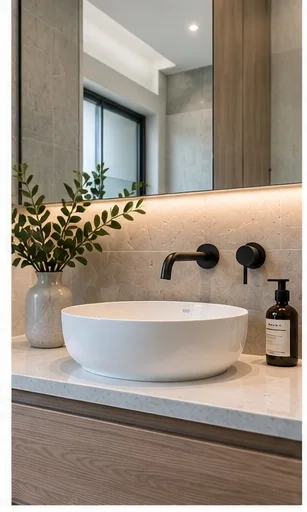
Wall-hung vanities show the floor underneath, which makes the room feel larger and makes cleaning easier — useful in a rental.
Mirror cabinets and wall types
A recessed mirror cabinet is the most space-efficient storage in a bathroom, but whether one can be recessed depends on the wall.
Stud and plasterboard walls — common inside newer apartments — can usually take a recessed cabinet, provided there are no pipes, cables or frames in the way.
Masonry walls — typical in 1960s and 1970s walk-ups — generally cannot be recessed without significant cutting, which the owners corporation may not allow.
Shared or fire-rated walls — between your unit and a neighbour's, or a corridor — must not be compromised. Recessing into them is generally off the table.
Where recessing is not possible, a slim surface-mounted mirror cabinet with integrated lighting does most of the same job.
Hiding the laundry
In walk-up units where the laundry is in the bathroom, cabinetry does the most work. A tall cupboard with a stacked washer and dryer behind doors, or a bench over a front-loader beside the vanity, removes the clutter. See laundry renovations.
Materials
Carcass. A moisture-resistant board with sealed edges resists swelling far better than standard chipboard.
Tops. Engineered stone, ceramic or a solid-surface top with an integrated basin. An integrated basin has no join to collect grime — sensible in rentals.
Fronts. Two-pack polyurethane, laminate or timber veneer. Laminate is durable and cost-effective, well suited to investment properties.
Hardware. Soft-close runners rated for bathroom humidity.
Light at the mirror
A single downlight in the ceiling puts your face in shadow. A backlit mirror or vertical lights either side are far more useful, and in a windowless ensuite they make a large difference.
Getting it in the building
A custom vanity has to fit in the lift and through the door. We measure the route as well as the room.
Costs
Off-the-shelf wall-hung vanity: roughly $900–$2,500. Custom vanity: roughly $2,500–$5,500. See the 2026 cost bands.
Call 02 4601 3371 or send the room details through.
Everything else we quote
Questions people ask before they commit
What vanity size suits a small apartment bathroom?
Often a narrower, shallower unit than the showroom default. A 400 to 450mm deep vanity keeps the walkway clear in a narrow room, and a width of 600 to 750mm suits most compact apartment bathrooms. A wall-hung unit with two deep drawers holds more than a wider cupboard vanity.
Can a mirror cabinet be recessed into the wall?
In a stud or plasterboard wall, usually yes, provided there are no pipes, cables or structural members in the way. In the masonry walls of older walk-ups, and in walls that are shared with a neighbouring unit or form part of a fire-rated separation, recessing is generally not an option, and a slim surface-mounted cabinet is used instead.
Can a wall-hung vanity be fixed to any wall?
It needs solid fixing. In a stud wall, timber noggings or a steel bracket go in at rough-in. In a masonry or concrete wall, heavy-duty anchors go directly into the wall. Shared and fire-rated walls may limit what can be done, which we check at the measure.
What does a new vanity cost?
A quality off-the-shelf wall-hung vanity with a stone or ceramic top typically runs $900 to $2,500. A custom unit built to the room's exact dimensions runs roughly $2,500 to $5,500. In a rental apartment, a durable off-the-shelf unit is usually the sensible choice.