Walk-ups, mostly
Harris Park is best known for its history and its restaurants. Residentially, though, much of the suburb is red-brick walk-up units built through the 1960s and 1970s, three or four storeys with no lift.
Their bathrooms have a lot in common: small, masonry-walled, on a concrete slab, often with a bath under the shower and the laundry tub and washing machine in the same room. Many were last renovated decades ago.
What we typically find
No working membrane. Older walk-up bathrooms often pre-date modern waterproofing practice. Grout and tile were doing the work, and after fifty years, they no longer are.
Asbestos possible. Linings or floor underlays from before about 1990 can contain asbestos cement. A sample is tested before the price is finalised.
Old pipework. Galvanised or early copper supply pipes, sometimes with poor water pressure.
Tired ventilation. A small window, sometimes painted shut, and no exhaust fan.
Walk-up logistics
No lift means everything goes up and down the stairs — tiles, adhesive, the vanity, and every bag of demolition waste. That takes labour and is built into the price.
Stairwells are common property. They are protected before work starts, and the owners corporation will want to know how.
Designing a walk-up bathroom
The walls do not move and the wastes stay where they are. Inside those limits:
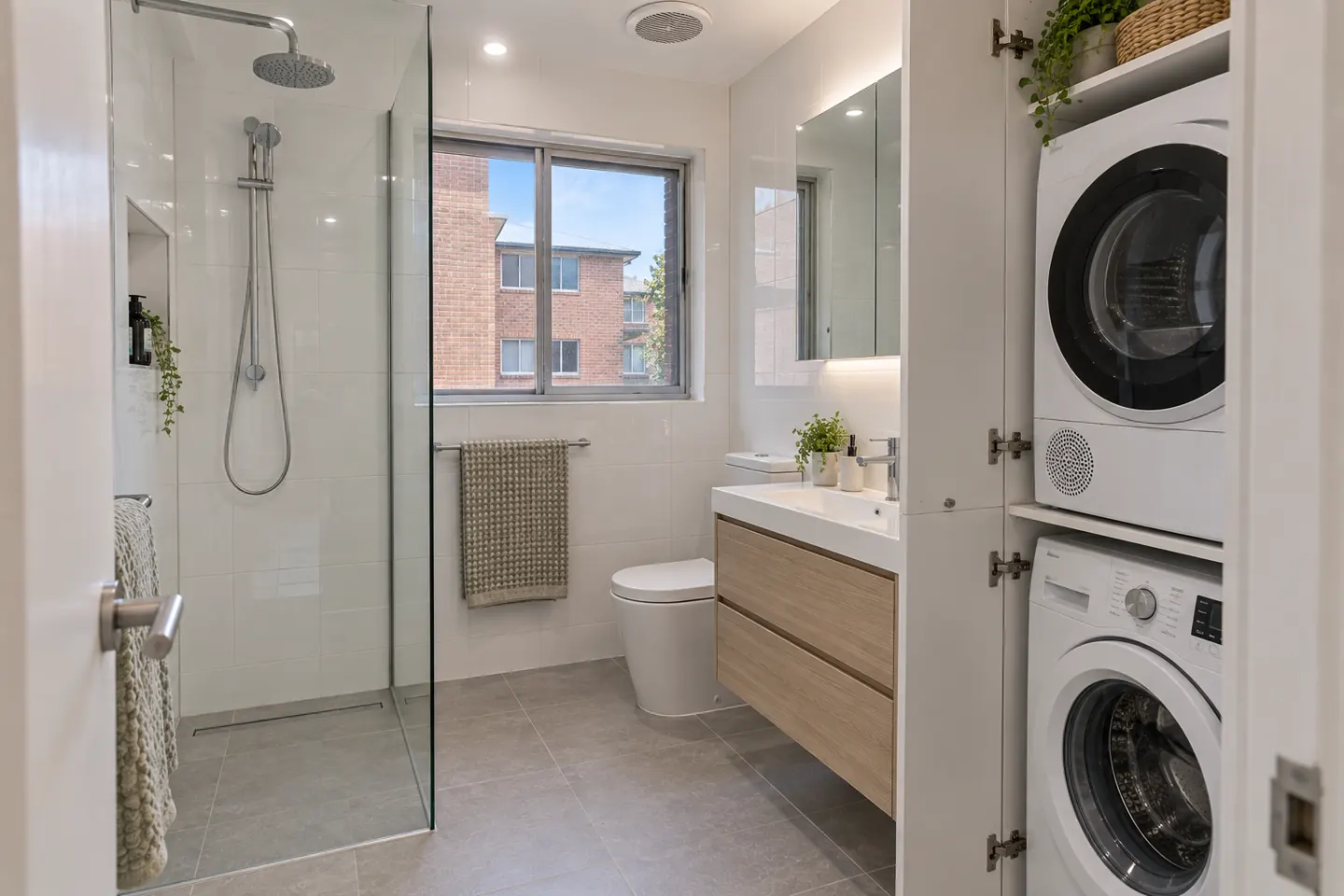
- Remove the bath and build a full-width shower with a single glass panel.
- Hide the laundry in a tall cupboard or under a bench.
- Wall-hung vanity with drawers.
- Tile to the ceiling.
- Add an exhaust fan where the building allows, or improve the window.
- Surface-mounted mirror cabinet, since the masonry walls will not take a recess.
See small bathroom renovations for more detail.
Strata approval
Even in a small walk-up, bathroom work involving waterproofing is generally a major renovation needing a special resolution at a general meeting. Smaller walk-up schemes sometimes have self-managed owners corporations, which can make meetings easier to arrange — or harder. See how a renovation runs.
Heritage cottages
Parts of Harris Park are heritage conservation areas, and some properties are individually listed. For houses, internal bathroom work is generally unaffected by a conservation area, but a new or changed window visible from the street may need consent. A listed heritage item can need consent for internal changes too.
For landlords
Many Harris Park units are rented. A durable, easy-to-clean bathroom with mid-range fittings suits the rental market here, and demolition can be scheduled at the end of a tenancy once approval is in place.
What it costs
Small walk-up bathroom: roughly $17,000–$26,000 before any asbestos removal. See the 2026 cost bands.
Nearby
We also work in Parramatta, Granville, Westmead and North Parramatta, plus Rosehill and Clyde.
Call 02 4601 3371 or send the room details through.
Other suburbs we cover
Questions people ask before they commit
Is asbestos likely in a Harris Park walk-up bathroom?
Possible. Walk-ups built in the 1960s and 1970s, and bathrooms renovated before about 1990, can contain asbestos cement in wall or ceiling linings, or in vinyl and underlay on the floor. It must be tested, not guessed. Removal is by a licensed asbestos removalist, and because linings may be common property, the owners corporation may need to be involved.
Does heritage affect a bathroom renovation in Harris Park?
Parts of Harris Park are heritage conservation areas, and some buildings are individually listed. Internal work in a unit generally is not affected. For houses, changes visible from the street — such as a bathroom window — can need consent, and a listed heritage item can need consent even for internal work.
My walk-up bathroom has the laundry in it. Can it be separated?
It usually cannot be moved to a separate room, but it can be hidden. A tall cabinet enclosing a stacked washer and dryer, or a bench over a front-loader, removes the visual clutter and makes the bathroom feel much bigger.
What does a walk-up bathroom renovation cost?
Roughly $17,000 to $26,000 for a small walk-up bathroom taken back to the slab in 2026, before any asbestos removal. That includes strata logistics such as waste removal without a skip.